

Dead Person Giving Food in a Dream in Islam
Seeing a deceased person give you food in a dream can feel comforting, unsettling, or deeply personal. In an Islamic context, however, there is no authentic Qur’anic verse or Prophetic hadith establishing one fixed meaning for this particular dream. Its interpretation depends on the dream’s details, the condition of the food, the deceased person’s behavior, and the dreamer’s circumstances.
Islam also does not teach that every dream is a divine message. The Prophet ﷺ distinguished between good dreams and distressing dreams, and taught believers how to respond to dreams they dislike. Sahih al-Bukhari and Sahih Muslim preserve this guidance. Therefore, a dream about a deceased person giving food should be treated as a possible reflection, reminder, or good vision rather than as a guaranteed prediction about the future.
| Dream situation | Possible interpretation and Islamic context |
|---|---|
| Dead person giving food to you | In traditional dream literature, receiving something beneficial from a deceased person can be viewed positively, particularly when the food is wholesome and the encounter is peaceful. It may also reflect memories of the deceased, gratitude for past care, or a reminder to appreciate lawful provision. It should not automatically be described as a message from the deceased. |
| Dead person offering bread | Bread is naturally associated with food, livelihood, and daily provision. In a classical-style interpretation, receiving fresh bread may therefore be read as a favorable symbol of stability or sustenance. This is a symbolic interpretation, not a specific teaching established by the Qur’an or Sunnah. |
| Dead person giving fruit | Fresh and pleasant fruit can suggest benefit, ease, or something enjoyable in one’s circumstances. The meaning can change according to the type and condition of the fruit and the dreamer’s feelings. Rotten fruit may instead reflect disappointment, anxiety, or concern about something in waking life. |
| Dead person giving meat | The condition of the meat matters more than the mere fact that it came from a deceased person. Cooked, wholesome food may be read more favorably in traditional symbolism, while raw or unpleasant meat may represent difficulty, discomfort, or an issue requiring attention. This should not be turned into a prediction of harm. |
| Dead person giving sweets | Sweets may symbolize pleasure, affection, celebration, or emotional comfort. When the deceased is remembered fondly, the dream may also arise from memories of kindness shared during life. |
| Dead person giving spoiled food | Spoiled food can represent something the dreamer finds unhealthy, disappointing, corrupt, or emotionally difficult. It may be useful to reflect on one’s finances, relationships, obligations, or habits, but there is no sound basis for saying that spoiled food proves the deceased is suffering. |
| Dead person feeding the dreamer | Being fed directly can make the dream feel especially intimate. It may reflect remembered care from the deceased or a need for comfort. Traditional symbolism may treat receiving nourishment favorably, but the emotional circumstances of the dream remain important. |
| Dead person giving food to family | This may reflect memories of family meals, shared responsibilities, or the deceased’s former role within the household. It can also prompt the living to maintain family ties and remember the deceased with sincere prayer. |
| Dead person giving food inside the house | A home setting can make the dream particularly connected to family memories and personal history. A peaceful home may accompany feelings of security, while a frightening or disorderly setting may reflect unresolved concerns. The setting alone does not establish a supernatural meaning. |
| Deceased mother giving food | A deceased mother may appear in a dream because of love, grief, memory, or a continuing sense of attachment. Receiving food from her can naturally symbolize remembered care and nourishment. It is appropriate to respond with gratitude and du’a rather than claiming certainty about her condition. |
| Deceased father giving food | A deceased father may represent remembered protection, responsibility, advice, or family provision. Food offered by him can therefore carry a strong personal association with care and responsibility, especially if those themes were important during his life. |
| Deceased relative giving food | The dream may be closely connected to family memories and the continuing emotional bond between relatives. It can be a useful reminder to preserve kinship, make du’a for the deceased, and do good without assuming that the dream itself creates a religious obligation. |
| Unknown deceased person giving food | An unknown deceased person makes personal interpretation more uncertain. The dream may represent an unfamiliar concern, a general reminder about mortality, or symbolic imagery without a specific message. Avoid assigning a definite meaning simply because the person was unknown. |
| Dead person giving dark or black food | Dark food is sometimes interpreted negatively in later symbolic dream literature, but color alone does not establish an Islamic meaning. Consider whether the food looked harmful, whether you felt fear, and what was happening in your waking life before attaching significance to the image. |
| Dead person giving white food | White and clean food may naturally evoke purity, peace, and simplicity. Such an interpretation can be comforting, but it should remain a symbolic reading rather than a claim that Allah has confirmed the dreamer’s spiritual status. |
| Dead person refusing to give food | Refusal may reflect distance, grief, disappointment, or a sense that something expected is unavailable. It does not prove that the deceased is angry or that the dreamer has been rejected spiritually. |
| Dead person taking food from the dreamer | This can be emotionally striking, particularly when the deceased was someone close. Islamic evidence does support giving charity on behalf of a deceased person, but a dream should not be treated as proof that the deceased is requesting a particular act. |
| Dead person giving food to a pregnant woman | Pregnancy can make dreams especially vivid because of physical, emotional, and family changes. Food offered by a deceased relative may represent comfort, family protection, or memories of support. It should not be presented as a prediction about the baby’s sex, health, or the outcome of childbirth. |
| Dead person giving food to a single woman | The dream may reflect companionship, family expectations, emotional needs, or memories of the deceased. It is not reliable evidence that marriage or another specific event will occur soon. |
| Dead person giving food to a married woman | The dream may connect with household responsibilities, family memories, or concerns about provision and stability. A pleasant dream can be received with gratitude without assuming that it guarantees prosperity or a particular future event. |
| Dead person giving food to a man | The image may relate to responsibility, provision, family expectations, or memories associated with the deceased. If the dreamer is facing financial or family pressure, those waking concerns may be especially relevant. |
| Eating food given by a dead person | Eating makes the dream more personal because the dreamer actively accepts what is offered. Pleasant food may symbolize acceptance, comfort, or benefit in a traditional reading, while unpleasant food may reflect anxiety or rejection. Neither interpretation is certain. |
| Refusing food from a dead person | Refusing may represent hesitation, grief, mistrust, or a desire to keep distance from something associated with the past. Its meaning depends strongly on whether the refusal felt peaceful, fearful, guilty, or deliberate. |
| Repeatedly seeing a dead person giving food | Repeated dreams deserve attention, but repetition does not automatically make an interpretation more certain. Recurring dreams can arise from grief, unresolved memories, stress, or persistent thoughts. The repeated image may be a useful prompt for reflection and prayer without being treated as a guaranteed supernatural instruction. |
What Does Receiving Food from a Dead Person Mean in Islam?
The strongest distinction to make is between Islamic guidance about dreams and traditional symbolic interpretation. The Qur’an demonstrates that some dreams can have meaningful interpretation. The story of Prophet Yusuf includes the interpretation of the king’s dream, showing that dream interpretation exists within the Islamic tradition. It does not, however, provide a fixed dictionary in which every food or deceased person has one universal meaning.
Classical dream literature developed symbolic approaches to individual images. A manuscript in the British Library contains an Ottoman dream-interpretation work attributed to Ibn Sirin, while the Columbia University Libraries’ Arabic Collections Online preserves a historical edition of Ta’tir al-anam fi ta’bir al-manam associated with al-Nabulsi and other dream-literature figures. These works are valuable for studying the history of Islamic dream interpretation, but they should not be confused with revelation or authentic Prophetic statements.
For that reason, receiving food from a deceased person may be discussed as a traditional interpretation, especially when the food is wholesome and the encounter is calm. It is much harder to justify statements such as “the deceased is definitely sending you a message,” “Allah is promising you provision,” or “this proves the deceased is in a particular spiritual state.”
Why the Food and the Dreamer’s Feelings Matter
The most useful details are often not the fact that the person was dead, but what happened during the encounter.
- Fresh, pleasant food: may fit a positive symbolic reading involving nourishment, comfort, generosity, or remembered affection.
- Spoiled or foul food: may reflect disgust, anxiety, disappointment, or concern about something in waking life.
- Peace and affection: may correspond with comforting memories of the deceased.
- Fear or pressure: should make the dreamer cautious about treating the dream as good news or as a command.
- Eating the food: may symbolize acceptance or participation, although the personal context remains decisive.
- Refusing the food: may express hesitation, grief, emotional distance, or concern about accepting something associated with the past.
- The deceased’s behavior: a familiar smile, conversation, silence, anger, or affection can change the emotional meaning of the dream.
These are interpretive possibilities, not fixed Islamic rules. A person who recently lost a parent, for example, may dream of being fed by that parent because food was an important expression of care during the parent’s lifetime. That explanation can be more relevant than a symbolic dictionary.
Does a Deceased Person Giving Food Mean They Need Something?
Not necessarily. It is common for dream interpretations to say that a deceased person appearing in a dream is asking for prayer or charity, but a dream by itself cannot establish that the deceased is making a request.
There is, however, sound Islamic evidence for doing good on behalf of the deceased. Sahih Muslim records that a person’s deeds end after death except for certain continuing benefits, including ongoing charity, beneficial knowledge, and a righteous child who prays for them. Other reports also establish that charity given on behalf of a deceased parent can benefit them.
Therefore, if this dream reminds you of someone who has died, making sincere du’a for them or giving voluntary charity on their behalf can be a good deed. The important distinction is that the good deed is supported by Islamic evidence; the dream is not proof that the deceased demanded it.
Positive and Negative Readings
A peaceful dream in which a deceased relative offers clean and enjoyable food may reasonably be experienced as comforting. Traditional symbolism may associate wholesome food with benefit, livelihood, generosity, or ease. The dreamer can thank Allah for any comfort the dream brings and remember the deceased with prayer.
A frightening dream, especially one involving rotten food, aggression, darkness, or intense distress, should not be treated as a prediction of disaster. Islamic guidance for a disliked dream is to seek refuge in Allah and not allow the dream to control one’s decisions. There is no need to turn an unpleasant dream into an omen about death, illness, financial loss, or punishment.
Does Seeing the Dream After Fajr Make It More Certain?
There is no reliable basis for saying that a dream is automatically more truthful because it occurred after Fajr. The timing of a dream should not be used as a shortcut for determining whether it came from Allah, from one’s own thoughts and experiences, or from a distressing source.
The more important questions are how the dream affected you, what was happening in your life, whether the dream repeats, and whether its interpretation is actually supported by Islamic evidence.
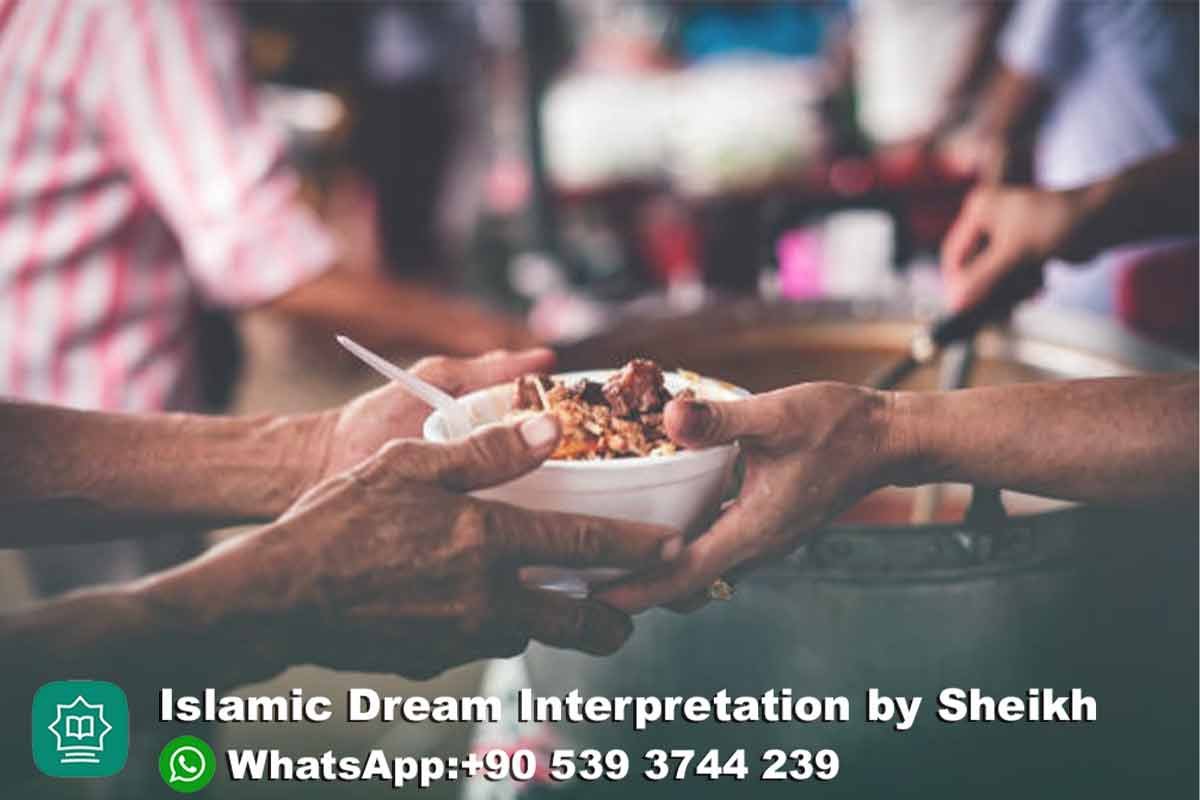
Deceased Mother, Father, or Relative Giving Food
When the deceased is someone close, personal history becomes especially important. A mother who regularly prepared meals may naturally appear offering food because food was part of the relationship. A father associated with providing for the household may appear in a similar way. A grandparent may be connected with hospitality, family gatherings, or childhood memories.
These personal associations do not make the dream meaningless. They simply prevent us from forcing every dream into a standardized symbolic formula. The same image can carry different significance for different people.
If the dream leaves you with affection and gratitude, it may be an opportunity to remember the deceased kindly and make du’a for them. If it leaves you frightened, follow the Islamic guidance for distressing dreams rather than trying to decode every frightening detail.
What If the Deceased Gives Food to a Pregnant Woman?
Pregnancy can intensify dreams because of changes in sleep, emotions, family concerns, and expectations about the future. A deceased mother, father, or relative giving food may therefore feel especially significant.
It is reasonable to understand a pleasant dream as emotionally reassuring, particularly if the deceased was a source of support. It is not sound to use the dream to predict the baby’s sex, guarantee an easy delivery, diagnose a health condition, or claim that the deceased has revealed the child’s future.
What If the Food Is Rotten, Raw, Dark, or Unpleasant?
Traditional dream symbolism sometimes treats unpleasant food negatively, but there is no authentic Islamic rule saying that a particular color, texture, or type of food always has one meaning.
Instead, consider what the food meant to you. Was it frightening because it looked contaminated? Did you feel disgusted? Were you worried about money, family, health, or something you had done? Such details may reveal more about the dream’s significance than a generalized symbol list.
If the dream causes you to reflect on your conduct, that reflection can still be beneficial. Review your obligations, seek forgiveness for genuine wrongdoing, correct any harm you have caused, and keep your earnings and dealings lawful. Those actions are valuable regardless of what the dream ultimately meant.
Islamic Guidance After a Dream About the Dead
If the dream was pleasant, there is no need to become obsessed with interpreting it. Thank Allah for any comfort you experienced and, if appropriate, share a good dream with someone you trust and love.
If the dream was disturbing, Islamic guidance is more practical than symbolic. Seek refuge in Allah from the evil of the dream, lightly spit or blow toward the left as taught in the hadith, and do not spread the frightening dream around. A distressing dream does not have to harm you.
You may also make du’a for the deceased. Voluntary charity on their behalf is another established good deed, supported by authentic reports, but it should be performed as an act of worship rather than because the dream has supposedly imposed an obligation.
There is also no requirement to perform istikhara merely because a deceased person appeared in a dream. Istikhara is a form of seeking Allah’s guidance when making a decision; it should not be turned into a method for decoding dreams or obtaining guaranteed predictions.
Common Misconceptions About Dead People Giving Food in Dreams
- It does not automatically mean death is approaching. A dream is not a reliable timetable for someone’s death.
- It does not prove the deceased is suffering. A frightening or unpleasant dream cannot establish the unseen condition of a person who has died.
- It does not prove the deceased is communicating a request. Prayer and charity can be offered without claiming that the dream created the request.
- Food does not have one universal Islamic meaning. Traditional interpretations vary according to context and source.
- The time of the dream does not make its interpretation certain. A dream after Fajr is not automatically a true dream.
- The dream should not control major decisions. Marriage, medical treatment, finances, and other serious decisions require sound evidence and consultation, not dream symbolism alone.
When Should You Speak to a Scholar?
Consider asking a knowledgeable and trustworthy scholar if a dream is recurring, causing significant distress, or making you uncertain about a religious obligation. A qualified scholar can also help distinguish between established Islamic guidance and claims that come from later dream literature or popular culture.
Be especially cautious if someone uses a dream to tell you that a specific event is guaranteed, that the deceased has definitely spoken to you, or that you must pay money or perform a particular ritual to prevent harm. Such certainty is not justified simply because someone claims expertise in dream interpretation.
Sources & Islamic Context
- Sahih al-Bukhari: guidance concerning good and distressing dreams
- Sahih Muslim: guidance concerning good and disliked dreams
- Qur’an, Surah Yusuf: the king’s dream and its interpretation
- Sahih Muslim: continuing benefits after death
- Sahih Muslim: charity given on behalf of a deceased mother
- British Library: historical manuscript attributed to Ibn Sirin’s dream-interpretation tradition
- Columbia University Libraries: historical edition of Ta’tir al-anam fi ta’bir al-manam
Final Perspective
A dream of a dead person giving food can be meaningful without having one guaranteed meaning. The most responsible Islamic approach is to separate what the Qur’an and authentic Sunnah actually establish from later symbolic interpretations. A peaceful dream may bring comfort and remind you of someone you loved; an unpleasant dream may simply call for the Prophetic response to distressing dreams rather than an elaborate prediction.
If the dream encourages you toward gratitude, sincere du’a, charity, repentance, stronger family ties, or lawful living, those are worthwhile responses regardless of the dream’s ultimate interpretation. The dream itself should remain a matter of reflection, not certainty about the unseen.