

The Islamic dream interpretation of Touching Feces in Dream meaning Islam can deeply unsettle a person, often leaving behind a sense of discomfort, confusion, or lingering concern after waking. Dreams involving impurity tend to feel especially disturbing because concepts of cleanliness and purity hold profound spiritual significance in Islam. Such imagery may symbolically touch upon themes of wealth, personal burdens, hidden matters, embarrassment, or moral unease. At Best Istikhara, visions of this nature are approached with care and balance, guided by the Qur’an, the Sunnah, and the disciplined insights of recognised classical scholars rather than simplistic symbolism.
Interpretation always depends on context. The identity of the dreamer, the emotions felt during the dream, whether the contact was accidental or deliberate, and details such as place, cleanliness, and timing all influence meaning. Even the difference between a fleeting image and a vivid, memorable scene can shape understanding, particularly for dreams seen after Fajr. This article moves thoughtfully from foundational meanings toward practical, situation-specific guidance, offering clarity that respects both scholarship and lived experience.
This dream might have a serious meaning. If you want your dream interpreted personally by our Sheikh, send us a message on WhatsApp: +90 539 374 42 39.
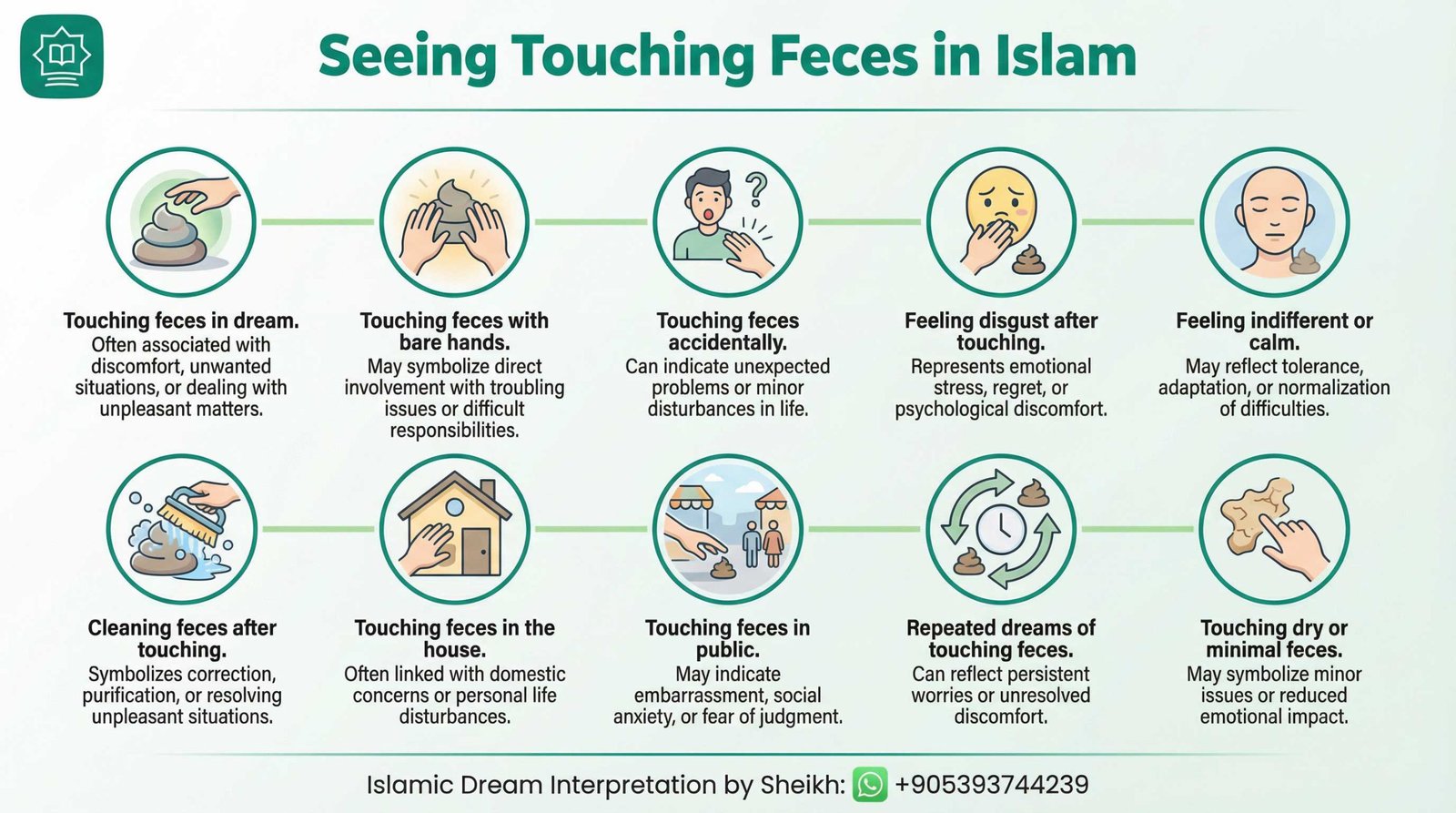
Different Conditions of Touching Feces in Dream meaning Islam
| Different Conditions of Touching Feces in Dream meaning Islam | Islamic Interpretation |
|---|---|
| Touching feces in dream meaning Islam | In the classical symbolic language of dreams, contact with feces often points to matters connected to wealth, burdens, or actions that evoke discomfort. When the dream carries no fear or disgust, scholars associated it with the release of worries or dealing with unpleasant but necessary worldly affairs. When accompanied by distress or shame, it may act as a reminder to review one’s conduct, income, or private dealings, encouraging tawbah and istighfār. |
| Accidentally touching feces in dream | Accidental contact tends to soften the symbolism. It may indicate unexpected involvement in awkward situations or minor disturbances rather than deliberate wrongdoing. Emotional calmness within the dream suggests passing concerns, while strong revulsion may hint at unease about a recent decision or interaction. Reflection, dhikr, and maintaining lawful means restore clarity. |
| Deliberately touching feces dream Islam | Intentional contact carries a stronger cautionary tone. It may symbolise conscious engagement with questionable matters, doubtful earnings, or ethically uncomfortable behaviour. The dream serves as a moral signal rather than a literal prediction, directing the dreamer toward self-correction, sincere tawbah, and safeguarding purity in actions and livelihood. |
| Cleaning feces after touching in dream | Cleansing imagery is frequently linked to relief and rectification. Washing or removing impurity symbolises the easing of burdens, repentance, or resolving matters that previously caused discomfort. This vision encourages optimism balanced with gratitude to Allah ﷻ and continued commitment to upright conduct. |
| Feeling disgust while touching feces dream | Strong disgust reflects inner resistance or moral discomfort. Such emotions may mirror anxiety, guilt, or concern about situations that trouble the conscience. The appropriate response is not fear but purification through istighfār, duʿāʾ, and distancing oneself from doubtful influences or actions. |
| No disgust when touching feces in dream | Absence of revulsion alters the symbolic reading. It may point toward neutral worldly matters, financial themes, or the handling of routine yet unpleasant responsibilities. Scholars emphasised that emotional neutrality can reduce the warning aspect, though mindful self-awareness remains beneficial. |
| Touching feces in house dream meaning | The house often symbolises personal life, family, or financial stability. Contact with impurity in this setting may relate to domestic concerns, responsibilities, or resources. Calm context may indicate manageable issues, while distress may prompt reflection on family dynamics or financial ethics. |
| Touching feces in public dream Islam | Public exposure intensifies symbolism connected to reputation, embarrassment, or social anxiety. The dream may reflect fears of judgment or vulnerability rather than actual disgrace. Maintaining dignity, guarding speech, and turning toward Allah ﷻ with composure are key responses. |
| Repeated dreams of touching feces | Recurrent visions suggest persistent thoughts or unresolved concerns occupying the mind. Classical scholars did not treat repetition as certainty but as a cue for introspection. Increased dhikr, istighfār, and thoughtful evaluation of ongoing stresses or decisions help settle the heart. |
| Touching feces after Fajr dream | Dreams seen after Fajr have traditionally been regarded as more coherent, though never infallible. Such timing may heighten personal relevance of the imagery. The dreamer is encouraged to respond with balance, avoiding exaggerated conclusions while strengthening remembrance of Allah ﷻ. |
| Touching child feces in dream meaning Islam | Contact involving a child may symbolically connect to responsibilities, care, or family-related concerns. It may reflect natural anxieties tied to duty or protection. The tone of the dream determines nuance; calmness suggests ordinary burdens, while discomfort may invite greater patience and reflection. |
| Stepping and touching feces in dream | Combined imagery of stepping and touching often symbolises unexpected inconvenience or entanglement in minor difficulties. Relief or cleansing within the dream suggests resolution, while persistent discomfort may hint at lingering frustration. Steady prayer and lawful conduct remain grounding anchors. |
| Touching animal feces dream Islam | Animals in dreams often represent instincts, environment, or external influences. Contact with their impurity may symbolise dealings with coarse or unpleasant aspects of life. Emotional response guides interpretation, with purification and composure remaining the recommended stance. |
| Touching feces and washing hands dream | Washing after contact strongly indicates correction, repentance, or removal of unease. The imagery aligns with renewal and relief, symbolically encouraging gratitude, continued istighfār, and confidence in Allah’s ﷻ mercy and guidance. |
Interpretation of the Touching Feces in Dream meaning Islam Dream According to Islamic Scholars
Interpretation of the Touching Feces in Dream meaning Islam Dream According to Islamic Scholars calls for restraint and subtlety, as classical authorities rarely treated symbols of impurity in a crude or literal manner. Within the interpretive legacy associated with scholars such as Ibn Sīrīn and al-Nābulsi, contact with filth may indicate matters connected to wealth, relief from hardship, concealed actions, or internal discomfort, depending entirely on surrounding details. Feces themselves were sometimes linked to money or release from burdens, yet physical contact often introduces a dimension of caution, hinting at embarrassment, doubtful gain, or involvement in affairs that disturb one’s inner sense of ṭahārah.
At times, such a vision may carry favourable implications. When the dream lacks revulsion, harm, or humiliation, and especially when it is followed by cleansing or relief, scholars understood the imagery as symbolic of worries being discharged or pressures gradually lifted by the will of Allah ﷻ. Emotional tone remains decisive; calmness suggests something very different from disgust or anxiety. Timing can also influence reflection, since dreams seen after Fajr have traditionally been viewed as more coherent, though never interpreted with absolute certainty.
When the dream evokes distress, shame, or lingering unease, scholars advised introspection rather than alarm. The symbol may serve as a gentle warning to review one’s earnings, conduct, or private actions, encouraging tawbah, increased istighfār, charity, and reconciliation where needed. Turning to Allah ﷻ through dhikr, maintaining sincere prayer, and safeguarding lawful means protect the heart from excessive worry. The enduring lesson is to treat such dreams as invitations toward ethical and spiritual refinement rather than rigid predictions.
Interpretation of the Dream of Touching Feces in Dream meaning Islam by Ibn Sirin
Interpretation of the Dream of Touching Feces in Dream meaning Islam by Ibn Sirin is approached through a lens of nuance, reflecting Ibn Sīrīn’s well-known method of weighing symbols alongside circumstance. In this classical perspective, feces may sometimes allude to wealth, relief, or the removal of burdens, yet direct contact often introduces a reminder of accountability. The imagery may point toward matters that bring discomfort, embarrassment, or questionable benefit, particularly when the dreamer experiences disgust or anxiety. Emotional response is central; a calm state carries implications distinct from distress or shame.
Favourable indications may arise when the dream involves cleansing, concealment, or a sense of relief after contact. Such details were traditionally associated with the easing of difficulties or the management of unpleasant but necessary worldly concerns by the permission of Allah ﷻ. By contrast, intense or publicly exposed scenes may function as moral cautions, gently urging the dreamer to examine personal conduct, speech, or sources of income. Context refines meaning further, as contact occurring in the house may symbolically relate to family or financial responsibilities. Dreams seen after Fajr have also been regarded as more weighty, though never definitive.
The appropriate response, consistent with Ibn Sīrīn’s interpretive spirit, is neither fear nor dismissal but thoughtful rectification. Increasing istighfār, renewing sincere tawbah, offering ṣadaqah, and preserving lawful means restore spiritual balance. Regular dhikr, attentive prayer, and istikhārah in moments of uncertainty steady the heart and guard against obsessive interpretation. The essential takeaway from Ibn Sīrīn’s approach is to treat such imagery as a prompt for purification and renewed reliance upon Allah ﷻ.
Interpretation of the Dream of Touching Feces in Dream meaning Islam by Imam Sadiq
Interpretation of the Dream of Touching Feces in Dream meaning Islam by Imam Sadiq is traditionally viewed through a moral and symbolic framework that emphasises inner states and ethical awareness. In teachings attributed to Imam Jaʿfar al-Ṣādiq, symbols of impurity often relate to matters of wealth, secrecy, relief, or actions that disturb spiritual equilibrium. Contact with filth may reflect engagement with situations that feel awkward, burdensome, or morally sensitive. Once again, the dreamer’s emotional condition shapes understanding; calmness differs greatly from disgust or unease.
In certain contexts, the vision may carry constructive implications. When contact is followed by cleaning, concealment, or a feeling of release, scholars associated the imagery with difficulties being resolved or pressures gradually lifted through the mercy of Allah ﷻ. Conversely, when distress or embarrassment dominates the dream, the symbol may serve as a subtle caution linked to conduct, speech, or earnings. Details such as setting also refine interpretation, since imagery occurring inside the house may symbolically connect to domestic or financial concerns. Timing, particularly dreams seen after Fajr, has historically been regarded as noteworthy without implying certainty.
The response encouraged within this interpretive tradition centres on correction and composure. Renewing tawbah, increasing istighfār, giving ṣadaqah, and safeguarding lawful means restore inner balance and protect the heart from excessive anxiety. Consistent dhikr, sincere duʿāʾ, and istikhārah during uncertainty reinforce reliance upon Allah ﷻ. The essential takeaway from this perspective is that such dreams invite purification of intentions, actions, and sources of sustenance.
What Does Touching Feces Symbolize in Dreams?
What Does Touching Feces Symbolize in Dreams? Within the classical Islamic tradition, symbols of impurity are rarely interpreted at face value. Contact with filth may represent concerns related to wealth, burdens, concealed matters, or emotional discomfort, with meaning shaped entirely by surrounding details. Scholars such as Ibn Sīrīn and al-Nābulsi sometimes associated feces with money or relief from hardship, yet physical contact frequently introduces an element of caution, suggesting involvement in affairs that feel uneasy or socially awkward. The dreamer’s internal state remains pivotal; calmness carries implications very different from disgust or fear.
Favourable implications may appear when the dream includes cleansing, relief, or the absence of humiliation. In such cases, imagery may symbolise worries being discharged or unpleasant responsibilities being managed by the will of Allah ﷻ. Disturbing or chaotic scenes, by contrast, may function as reminders encouraging ethical reflection rather than anxiety. Contextual cues refine understanding further, including whether the contact occurs inside the house or in an exposed environment. Timing may also hold interpretive weight, as dreams seen after Fajr have long been regarded as more stable in traditional thought.
The sound response centres on grounding and rectification. Increasing istighfār, renewing tawbah, preserving lawful earnings, and turning toward Allah ﷻ with steady dhikr and sincere duʿāʾ protect the heart from obsessive concern. The essential takeaway is that such dreams call the believer toward conscious purification and balanced reliance upon Allah ﷻ.

Positive vs Negative Meanings of the Dream
Positive vs Negative Meanings of the Dream rest upon a delicate balance recognised by classical Islamic scholars, who rarely judged symbols of impurity in isolation. Touching feces may carry favourable or cautionary implications depending on emotional tone, context, and subsequent actions. Favourable indications may arise when the dream lacks distress or humiliation, particularly if the contact is followed by cleansing or relief. Such imagery has historically been linked to burdens being lifted or pressures gradually released by the permission of Allah ﷻ. Emotional neutrality within the dream often softens the symbolic weight.
Less favourable readings emerge when the dream is marked by disgust, anxiety, or public embarrassment. In these instances, scholars frequently regarded the symbol as a gentle warning rather than a prediction of harm, encouraging reflection upon earnings, behaviour, or unresolved concerns. Details refine interpretation; contact within the house may symbolically relate to family or financial matters, while lingering dirtiness may reflect inner unease. Timing, including dreams seen after Fajr, may intensify personal relevance without establishing certainty.
The proper response integrates composure with ethical awareness. Turning toward Allah ﷻ through istighfār, sincere tawbah, dhikr, and attention to lawful means restores clarity and balance. Acts of ṣadaqah and reconciliation further align the dreamer with purification. The essential takeaway is that distinguishing constructive from cautionary aspects of such a dream should lead to thoughtful self-correction and renewed trust in Allah ﷻ.
Timing, Repeated Dreams, and After Fajr Visions
Timing, Repeated Dreams, and After Fajr Visions have long been considered meaningful factors within the Islamic understanding of dreams. Scholars observed that visions seen nearer to the early morning, particularly after Fajr, may be less influenced by daily agitation or physical disturbance. Such timing does not guarantee literal truth, yet it may lend greater coherence to the imagery. When symbols of impurity appear at this hour, attention is directed toward emotional tone and waking circumstances rather than immediate conclusions. A calm vision differs greatly from one marked by anxiety or disgust.
Repeated dreams introduce another dimension. Classical scholars did not treat recurrence as proof of destiny, but as a sign worthy of reflection. Repetition may indicate persistent thoughts, stress, or unresolved concerns occupying the mind. Context remains decisive, including whether the imagery occurs in the house or elsewhere, and whether relief or discomfort dominates the dream. Personal conditions also shape nuance, as meanings may subtly differ for a man, a married or single woman, or a pregnant dreamer.
The sound response emphasises steadiness and balance. Increasing istighfār, engaging in dhikr, safeguarding lawful earnings, and turning to Allah ﷻ with sincere duʿāʾ protect the heart from excessive worry. When uncertainty persists, istikhārah and thoughtful reliance upon lawful means restore clarity. The essential takeaway is that dreams distinguished by timing or repetition should encourage measured reflection and renewed trust in Allah ﷻ.
What to Do After Seeing Touching Feces in Dream meaning Islam in Dream?
What to Do After Seeing Touching Feces in Dream meaning Islam in Dream? The first principle is composure, since dreams are not treated as automatic verdicts but as symbolic experiences requiring balance. Imagery of impurity often provokes discomfort, yet meaning depends on context, emotion, and the dreamer’s reality. A calm dream may simply echo passing impressions, while one marked by disgust or anxiety may serve as a reminder toward purification. Timing, including visions seen after Fajr, may influence reflection without implying certainty.
When unease remains, the appropriate response is spiritual recalibration rather than fear. Turning toward Allah ﷻ with sincere istighfār, maintaining regular ṣalāh, and renewing tawbah restore inner equilibrium. Scholars frequently encouraged safeguarding lawful earnings and conduct, recognising that symbols of impurity may hint at matters of dignity or responsibility. If the dream involves the house, thoughtful reflection upon family or financial concerns may be appropriate without drifting into suspicion.
Practical grounding prevents excessive preoccupation. Consistent dhikr, sincere duʿāʾ, and commitment to lawful means anchor the heart and mind. Istikhārah remains beneficial when the dream coincides with genuine decisions, ensuring guidance is sought through worship rather than anxiety. The essential takeaway is that such dreams are best met with remembrance of Allah ﷻ, ethical awareness, and calm trust rather than worry-driven conclusions.