

Dreams have always been a mysterious part of human life—sometimes inspiring, sometimes confusing. But what happens when a woman experiences a wet dream? Is it even possible? And more importantly, what does Islam say about it?
Many Muslim women hesitate to ask such questions due to cultural taboos, but understanding the reality and Islamic rulings is essential. Ignoring it could lead to misunderstandings about purity, ghusl (ritual cleansing), and even sin.
If you are a Muslim woman experiencing wet dreams, it’s crucial to know whether it can cause sin and what you should do next. Your dreams might have meanings, and ignoring them could be a mistake. Our Sheikh can interpret your dream and guide you with solutions to prevent sin. Send us a message on WhatsApp (+90 539 374 42 39) for a private and confidential interpretation.
Do Women Experience Wet Dreams According to Islamic Teachings?
Many Muslim women wonder whether they can experience wet dreams and, if so, what Islam says about them. While this topic is often overlooked due to cultural sensitivities, it is essential to understand it from an Islamic perspective.
Does Islam Acknowledge Wet Dreams in Women?
Yes, Islam acknowledges that both men and women can experience wet dreams (ihtilam). The evidence comes from an authentic hadith in which Umm Salama (RA) asked the Prophet Muhammad (ﷺ):
“O Messenger of Allah, does a woman also experience wet dreams?”
The Prophet (ﷺ) replied:
“Yes, if she sees water (discharge), she must perform ghusl.” (Sahih al-Bukhari 130, Sahih Muslim 313)
This hadith confirms that women, like men, can have nocturnal emissions and are required to perform ghusl (ritual purification) if they notice any discharge.
Is Experiencing a Wet Dream a Sin in Islam?
No, experiencing a wet dream is not a sin. Since dreams occur involuntarily, a person is not held accountable for them in Islam. However, what matters is how one reacts upon waking. If there is evidence of discharge, it becomes obligatory to perform ghusl before engaging in acts of worship such as prayer or reciting the Quran.
What Should a Muslim Woman Do After a Wet Dream?
If a woman wakes up and finds no physical discharge, she does not need to perform ghusl. But if she notices wetness, she should take a full ritual bath (ghusl) following the proper method:
- Make the intention (niyyah) for purification.
- Wash the private parts to remove any impurity.
- Perform wudu (ablution) as done for prayer.
- Pour water over the head three times, ensuring it reaches the roots of the hair.
- Wash the entire body thoroughly.
This ensures she is ritually pure and ready for acts of worship.
What Do Wet Dreams of Women Mean in Islamic Dream Interpretation?
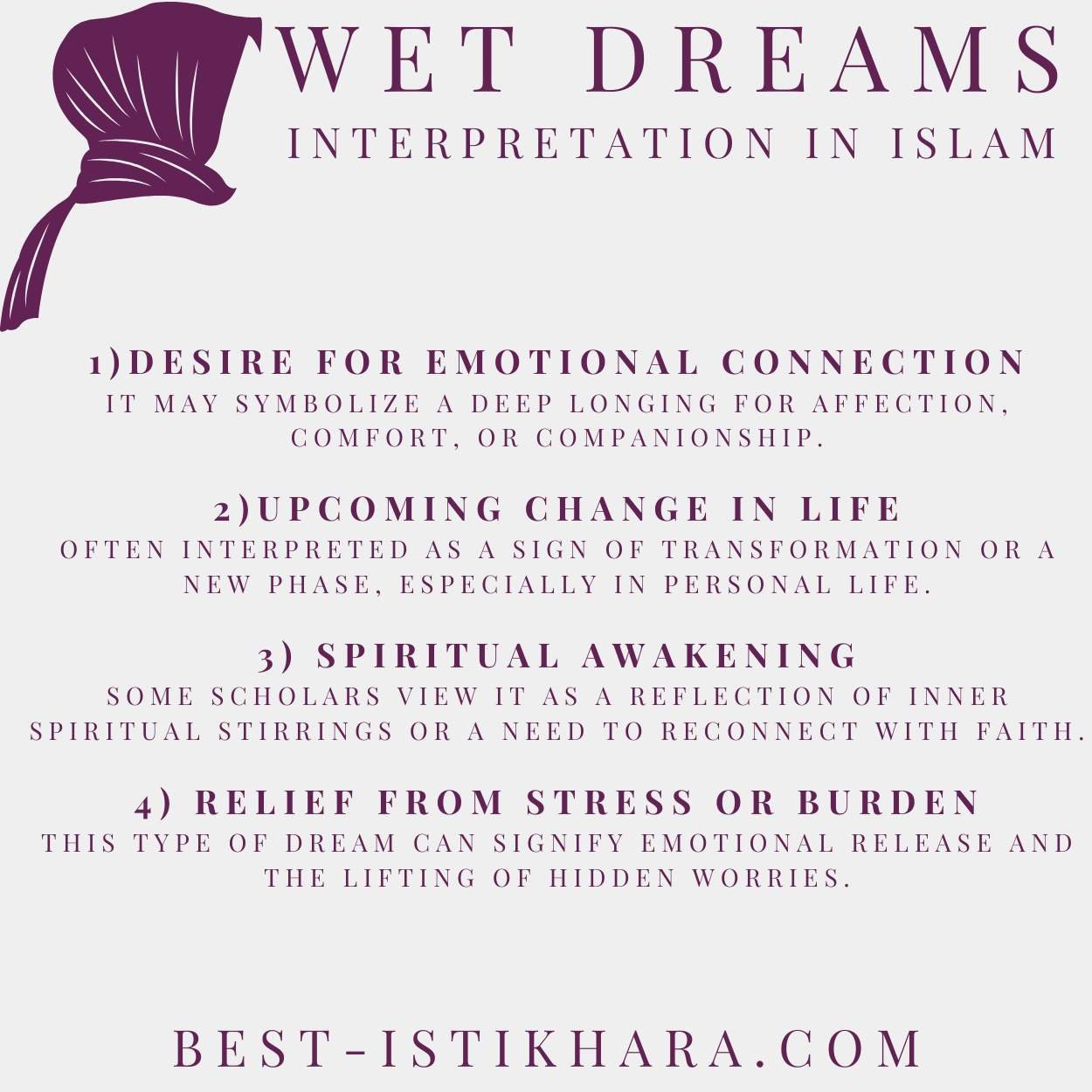
In Islamic dream interpretation, wet dreams experienced by women carry layered symbolic meanings rather than literal judgments. Classical scholars like Ibn Sirin, a renowned interpreter of dreams in early Islam, emphasized that such dreams should be understood not as physical events alone, but as reflections of the inner state — emotional, spiritual, or psychological.
From an Islamic lens, dreams involving sexual imagery or feelings of pleasure are often interpreted as metaphors for emotional longing, personal transformation, or even spiritual awakening. These are not considered shameful or impure in themselves, especially when they occur involuntarily. Islam distinguishes clearly between a dream and an intentional action, and therefore such visions do not indicate sin or wrongdoing.
To help illustrate this better, consider the following symbolic meanings based on Islamic dream analysis:
| Dream Element | Islamic Interpretation |
|---|---|
| Experiencing pleasure or climax | Desire for emotional connection, fulfillment, or upcoming comfort |
| Seeing water or washing oneself | A sign of purification, repentance, or divine mercy |
| Being intimate with someone unknown | Inner conflict, hidden desires, or suppressed feelings needing resolution |
| Feeling guilt or shame in the dream | A call for spiritual reflection or reconnection with one’s fitrah (natural state) |
These meanings are not fixed; the context, emotions, and life circumstances of the dreamer all influence how the dream should be interpreted. Islamic scholars often caution against over-interpreting dreams without proper knowledge or guidance, and recommend seeking help from someone learned in both fiqh and ta’bir al-ru’ya (Islamic dream interpretation).
If a woman repeatedly experiences inappropriate dreams, it may be beneficial to seek protection through duas before sleeping, such as:
🔹 Reciting Ayat-ul-Kursi (Surah Al-Baqarah 2:255)
🔹 Reading Surah Al-Falaq and Surah An-Nas
🔹 Sleeping in a state of wudu
If you are experiencing frequent wet dreams and wonder about their interpretation, our Sheikh can analyze your dream privately and provide Islamic guidance. Message us on WhatsApp (+90 539 374 42 39), and we will help you understand its meaning and how to prevent sinful thoughts. Your privacy is our priority!
Distinguishing Between Different Types of Vaginal Discharges in Islam
Vaginal discharge is a natural occurrence in a woman’s body, but many Muslim women are unsure about its rulings in Islamic purity (taharah). Is every type of discharge impure (najis)? Does it break wudu? When is ghusl required?
Understanding the Islamic perspective on different types of vaginal discharges is essential to ensure correct worship, maintain ritual purity, and avoid unnecessary doubts. Let’s explore this in light of Islamic teachings.
1. White or Clear Discharge (رطوبة الفرج)
What Is It?
This is a normal, colorless or whitish discharge that a woman’s body naturally produces throughout the menstrual cycle to maintain vaginal health. It is often present daily, especially before ovulation.
Does It Break Wudu?
🔹 According to many scholars, this type of discharge does not break wudu unless it is impure or caused by excitement.
🔹 Some scholars, particularly from the Hanafi school, hold that any vaginal discharge nullifies wudu as it exits from the private area.
Best Practice: If you frequently experience this, you can renew wudu for each prayer, similar to the ruling for people with continuous leakage issues (istihada).
2. Sexual Discharge (مذي و مني – Madhi & Mani)
1. Pre-Ejaculatory Fluid (Madhi – مذي)
🔹 This is a thin, sticky fluid that may be released when feeling aroused but before full sexual excitement.
🔹 Islamic Ruling: It is impure (najis) and nullifies wudu. However, ghusl is not required—only washing the affected area and renewing wudu is needed.
2. Ejaculatory Fluid (Mani – مني)
🔹 This is thicker, white/yellowish discharge released during sexual climax, including in wet dreams.
🔹 Islamic Ruling: It is pure (tahir) but requires ghusl for purification.
Prophet Muhammad (ﷺ) said:
“When you see (sexual) fluid, perform ghusl.” (Sahih Muslim 313)
Thus, if a woman experiences a wet dream or sexual climax, she must perform ghusl janabah before resuming prayers.
3. Menstrual & Post-Menstrual Discharge
Menstrual Blood (حيض – Hayd)
🔹 Any red, brown, or black blood during the menstrual period is considered hayd.
🔹 Islamic Ruling: A woman is exempt from prayer and fasting while menstruating.
Brown or Yellow Discharge After Menstruation
🔹 If seen within the normal menstrual cycle, it is part of menstruation (hayd).
🔹 If seen after the period ends and purity is confirmed, it is considered istihada (irregular bleeding) and does not prevent prayer.
Umm Atiyyah (RA) said:
“We did not consider brown and yellow discharge after tuhr (purity) as anything significant.” (Sunan Abu Dawood 307)
4. Postpartum & Irregular Bleeding
Nifas (Postpartum Bleeding)
🔹 Occurs after childbirth and can last up to 40 days.
🔹 During this time, a woman is exempt from prayer and fasting, similar to menstruation.
Istihada (Irregular Bleeding)
🔹 If a woman experiences constant or irregular bleeding beyond menstruation, it is not considered hayd.
🔹 She must perform wudu for each prayer but can continue worship.
Prophet Muhammad (ﷺ) told Fatimah bint Abi Hubaysh:
“When it is menstruation, stop praying, but if it is istihada, perform wudu for each prayer.” (Sahih Bukhari 228)
Interpretation of Erotic Dreams for Muslim Women: Insights from Islamic Scholars
Islamic scholars classify dreams into three types:
1. Dreams from Allah (Ru’ya صالحة)
These are true dreams that bring glad tidings, warnings, or insights. Erotic dreams generally do not fall into this category unless they symbolize something deeper.
2. Self-Reflections (Hadith an-Nafs حديث النفس)
These dreams are a reflection of a person’s daily thoughts, desires, or emotions. If a woman has been thinking about something or has certain feelings, her subconscious may replay them in her dreams.
3. Dreams from Shaytan (Huloom حلم الشيطان)
Erotic or disturbing dreams often fall under this category. Shaytan tries to tempt and mislead believers, sometimes through inappropriate dreams.
The Prophet Muhammad (ﷺ) advised:
“Good dreams are from Allah, and bad dreams are from Shaytan. If one of you sees something he dislikes, let him seek refuge with Allah and spit lightly to his left, and it will not harm him.”
(Sahih al-Bukhari 3292, Sahih Muslim 2261)
Thus, if a Muslim woman experiences an inappropriate dream, she should:
✅ Say ‘A’udhu Billahi Minash-Shaytanir-Rajeem’ (I seek refuge in Allah from Shaytan).
✅ Spit lightly to her left three times (without actual saliva).
✅ Avoid telling others about the dream unless seeking Islamic guidance.
Need an Islamic Dream Interpretation?
If you are experiencing recurring inappropriate dreams and feel unsure about their meaning, our Sheikh can provide private dream interpretation based on Islamic teachings.
📩 Send us a message on WhatsApp (+90 539 374 42 39), and we will help you understand your dream’s meaning and guide you on how to prevent sinful thoughts. Your privacy is our priority!